
Hot Fuzz and Deep Impact Are Not Time Travel Movies

Introduction
Picture this. You are scrolling through your favorite streaming service, ready to settle in for a night of mind-bending time travel movies. A title catches your eye. Hot Fuzz. You pause. That is a buddy cop comedy about small-town secrets, right? Then you see another recommendation. Deep Impact. You know that one. It is a 90s disaster film about a comet headed for Earth. Neither of these films has anything to do with time travel. Yet there they are, sitting on lists of supposed time travel movies.
It feels wrong, and you are not alone. Many movie fans run into this kind of mislabeling. General recommendation platforms and streaming algorithms often group films by broad themes, missing the finer points of genre. A study on movie genre classification shows that even automated systems struggle to correctly place films when they contain overlapping elements like action, drama, or science fiction.

IMDb Movie Genre Predictor is one attempt to solve this, but the problem remains everywhere.
These errors waste your time. You click on a suggestion expecting a journey through time, and instead get a comedy with no temporal twist or a disaster movie fixed in the present.

The frustration builds as you hunt for real time travel stories.
That is where this article comes in. We are going to break down exactly why Hot Fuzz and Deep Impact sometimes get thrown into the time travel category. More importantly, we will clear up what actually defines a time travel film. And we will point you toward better alternatives so you never waste another evening on the wrong movie.
If you are tired of sifting through inaccurate suggestions, we have a resource that focuses only on real time travel cinema.

Check out our curated list of time travel movies on Tubi for films that truly fit the genre, not just the algorithm’s guess.
Stick with us. By the end, you will know the difference between a miscategorized classic and a genuine time travel gem.
The Mislabeling Phenomenon: Why Non-Time Travel Movies End Up on Time Travel Lists
So why does this keep happening? Why do movies like Hot Fuzz and Deep Impact keep showing up where they do not belong?
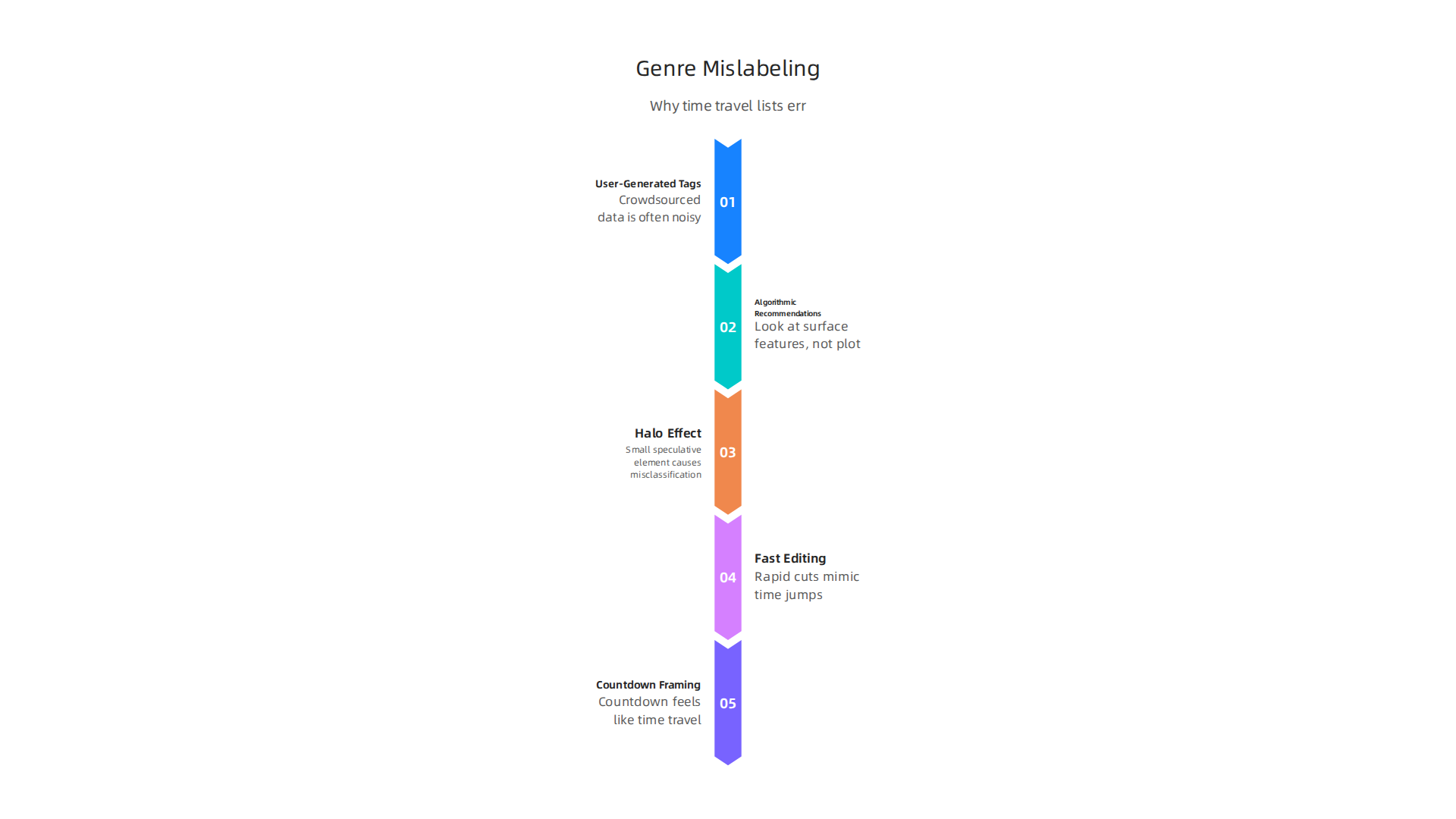
The first reason is user-generated tags. Platforms like IMDb and Letterboxd let anyone add genre labels to movies. That sounds helpful, but it often creates a mess. Someone sees a film with a single sci-fi element, like a comet in Deep Impact, and tags it as science fiction. Then another user adds "time travel" because it feels futuristic. Before you know it, a disaster movie about asteroids gets lumped in with Back to the Future. This crowdsourced data is noisy. Research into movie genre classification shows that even automated systems trained on thousands of scripts still struggle to get genres right. The IMDb Movie Genre Predictor is a cool experiment, but it only works with 12 broad categories, leaving no room for the nuance of time travel mechanics.
The second problem is algorithmic recommendations. Streaming services and movie list sites do not read film scripts. They look at surface features. Things like pacing, tone, and overall themes. A movie like Deep Impact is serious, has high stakes, and deals with a world-changing event. An algorithm sees those features and says, "This looks like The Day the Earth Stood Still or 12 Monkeys." It never checks whether the plot actually involves characters moving through time. A study on movie genre classification via scene categorization shows that even advanced models rely on visual cues like color and action, not story logic. So the algorithm groups movies based on mood, not meaning.
Then there is the halo effect. This is when a movie has one small speculative element and gets treated like a full-blown time travel film. Deep Impact has a comet from space. That is a futuristic or apocalyptic idea. So the film gets pulled into the sci-fi category, and from there into time travel lists. Hot Fuzz might get tagged because of its fast pacing and a few surreal moments, but it has zero time travel in its plot. The same thing happens with Heat movie, a 1995 crime drama with no sci-fi at all. But because Heat is intense and features a lone detective, algorithms sometimes suggest it alongside time travel thrillers.
The lesson is simple. Watch out for these traps. If a movie recommendation feels off, check the plot summary. Do not trust the tags alone. And if you want lists that actually respect the genre, stick with curators who focus on real time travel stories. You can start with our list of time travel movies on Tubi. No comets, no comedies, just actual time travel.
Hot Fuzz: The Illusion of Time Travel
Have you ever watched Hot Fuzz and felt like you were in a time warp? You are not alone. That feeling comes from the editing, not a time loop.
The film is famous for its fast, snappy visual style. According to data on average shot length, the typical movie has a shot length of over 16 seconds.

Hot Fuzz, on the other hand, has an average shot length of just 2.08 seconds. It packs over 3,300 shots into its 121-minute run. This rapid-fire editing creates a feeling of temporal distortion. Your brain does not get a break. It feels like time is speeding up or jumping around. This is why some people incorrectly tag it as a time travel movie. The Average Shot Length data for Hot Fuzz shows just how unique its pacing is.
But when we look at the actual plot, there is zero time travel. Nicholas Angel moves from London to Sandford. He solves a mystery. He fights the Neighborhood Watch Alliance. There are no time loops, no alternate timelines, and no paradoxes. It is a straight-up action comedy. Just like Deep Impact movies get mislabeled for having a comet, Hot Fuzz gets mislabeled for its intense pace. Some fans point to the "Three Flavours Cornetto Trilogy" and call it a time travel sequel. This is a stretch. Shared cameos are not time travel.
Hot Fuzz is a brilliant movie. But it is not a time travel movie. If you are looking for films that actually use time travel as a plot device, check out our list of stream the best time travel movies from 2025 and 2026. These films use temporal distortion as part of their story, not just their style.
The ‘Fast’ Edit and Temporal Confusion
So why does Hot Fuzz feel like a time travel movie? The answer is in the editing room. Director Edgar Wright uses a toolbox of tricks that confuse your brain into thinking time is bending. He relies on whip pans, match cuts, and rapid montages. These techniques create a visual flow that mimics skipping forward through time.
Think about it. A typical film has an average shot length (ASL) of over 10 seconds. Hot Fuzz clocks in at just 2.08 seconds per shot, as noted by film scholars studying Average Shot Length of Selected Films. Your eyes get no rest. The cuts come so fast that your mind might interpret them as time jumps.

But here is the key difference. In real time travel movies like Primer, the editing is intentionally disorienting to show actual temporal loops. In Tenet, scenes run forward and backward to visualize time inversion. Wright’s style is purely cinematic showmanship. It is about pacing and comedy, not paradoxes.
If you want to see how directors truly use editing to tell time travel stories, check out movies that use memory as a clever time machine. They use cuts to bend time for real.
Common Misconceptions: Fan Theories and Genre Confusion
So, now we know the editing is extremely fast. But why do some people insist these hot fuzz movies are secretly time travel films? It mostly comes down to a few common misconceptions that spread online.
The "Greater Good" montage in the third act is a prime example. It stitches together scenes of the Neighborhood Watch Alliance in fast succession. To some eyes, this feels like a time collapse. In reality, it is just a stylistic summary. Edgar Wright is showing you the evidence, not bending reality.
Internet memes picked up on this breathless pace and ran with it. What started as a funny observation about the film’s cutting evolved into a literal claim for some viewers. If you check the official Wikipedia page for Hot Fuzz or IMDb, you will not find a time travel tag. The film has an average shot length of just 2.08 seconds, which tricks your brain, but the narrative itself stays firmly in the present.
Compare this to genuine genre entries. While deep impact movies or the best 90s movies build clear cause-and-effect timelines, Hot Fuzz scrambles your visual perception without ever actually looping a second. A movie like Heat uses long, slow takes for tension. Wright uses rapid cuts for comedy. Both work, but only one is time travel.
If you are looking for films that truly use memory or emotion to travel through time, explore titles that deliver an emotional payoff rather than just a fast edit.
Deep Impact: A Countdown, Not a Time Loop
Let’s keep the confusion going. If hot fuzz movies can trick people into thinking they are time travel, then deep impact movies face the same problem.
Deep Impact is one of the best 90s movies in the disaster genre. It tells the story of a comet heading straight for Earth. The whole movie runs on a strict countdown clock. Every scene brings us closer to impact. Nobody goes back in time.

Nobody jumps forward. The characters feel time pressure, sure. There is a ticking clock in their heads and on their screens. But that is not the same as time travel.
Compare this to a film like Heat. That movie uses long, slow takes to build tension. Deep Impact uses a literal countdown. Both are linear. Neither bends time.
True time travel films often use what is called an anachronic order.

That means the story jumps back and forth along the timeline. Deep Impact never does that. Every scene follows the one before it in order.
So why do some people lump Deep Impact in with the time travel genre?
Part of it comes from the word "impact" itself. It sounds sudden and world changing. When you have an apocalyptic setting, your brain reaches for familiar labels. Since many time travel stories involve disasters or end of the world scenarios, Deep Impact gets grouped in by mistake.
Time travel has clear rules. As discussed in common time travel movie tropes, real time travel stories either send someone physically to the past or future, or they loop a moment. Deep Impact does none of that. The timeline stays perfectly straight. As one writer explains, time is linear and goes in one direction, and we are just along for the ride. That describes Deep Impact perfectly.
If you want a true time travel experience, skip the countdown. Check out emotional time travel movies that use memory as a time machine instead. These films do not just count down. They rewind.
Linear Narrative vs. Time Manipulation
Real time travel movies work differently than Deep Impact. Take 12 Monkeys from 1995. That film uses the anachronic order structure. The timeline jumps back and forth. Characters physically move through time. The same goes for The Time Machine (2002). These are true time travel stories.
Deep Impact stays on a straight line. There are no loops, no rewinds, no parallel timelines. Yes, the film has flashbacks. But flashbacks are just memories. They do not bend time. As one writer explains, time is linear and goes in one direction, and Deep Impact keeps that line straight.
So when you want a real time travel experience, skip the countdown. Watch films that use actual time manipulation. You can stream the best time travel movies from 2025 and 2026 to see how true time bending feels. These movies change the timeline. Deep Impact just runs out the clock.
Disaster Film Tropes That Resemble Time Travel Concepts
Among the best 90s movies, Deep Impact is a disaster film that uses tropes feeling like time travel. But they are different.
Take the countdown clock. It creates a structure similar to a time loop. Characters race against an inevitable moment. But there is no reset. True time travel movies let you rewind.
The same goes for "what if" scenes. Deep Impact shows hypothetical outcomes. Characters imagine different choices. But these are just guesses, not actual timeline changes.
Then there is fate. Knowing the comet is coming gives characters foreknowledge. That overlaps with time travel. But knowing the future is not the same as changing it. As this list of common time travel tropes explains, real time travel requires action.
So deep impact movies borrow some time travel flavor. But films like Hot Fuzz and Heat use completely different storytelling tools. If you want the real thing, skip the disaster genre. Stream the best time travel movies from 2025 and 2026 to see the difference.
What Defines a Time Travel Movie? A Clear Framework
So you want the real thing. Let’s pin down what actually makes a movie a time travel movie. It sounds simple, but plenty of films get the label without earning it.
Here is the core rule: a character must physically or mentally travel to a different time period. That means their consciousness or body actually moves. A countdown clock, a montage, or a flashback does not count. Just imagine the scene. In Hot Fuzz, Angel recalls past events. That is a memory, not time travel. In Heat, McCauley plans his next heist. That is strategy, not time travel. And in Deep Impact, the comet countdown builds pressure. That is a ticking clock, not a time machine.
As film historian Gabriel Miller points out, early cinema transported audiences through reenactments and fantasies. But real time travel in fiction is different. It requires a mechanism, a rule, and a consequence. The history of time travel films shows that audiences always loved the idea of moving through time. But the best examples follow clear logic.
The Subgenres of Time Travel
Time travel movies usually fall into a few main categories.

Knowing these helps you spot the real deal.
- Time Loops: The character relives the same period over and over. Every action resets. Groundhog Day is the classic. The character truly travels through time, even if it is only one day.
- Alternate History: A character changes the past, creating a new timeline. Think Back to the Future. Marty alters events and the future shifts.
- Fixed Timeline: The character travels to the past, but their actions were always part of history. They cannot change anything. 12 Monkeys works this way.
- Paradox Exploration: The story focuses on logical contradictions, like the grandfather paradox. Does killing your ancestor erase you? These movies often play with cause and effect.
Research on time travel in fiction explains that these subgenres have been common since the late 19th century. They all share one thing: the character actually goes to another time.
The Simple Test
Here is a quick check you can use on any movie. Ask: do the actions of the character change the past or the future?

If the answer is no, it is probably not a time travel movie.
For example, in Deep Impact, the characters know the future but cannot change it. The comet still hits. That is foreknowledge, not time travel. In Hot Fuzz, Angel solves crimes in the present. He never visits another time period. And in Heat, the timeline is straight. No one travels.
Real time travel movies let you see the consequences of change. A traveler goes back, does something different, and the world shifts. That is the magic. If you want to see this in action, check out how some movies use memory as a time machine. It is a creative twist that still follows the rule.
So next time someone calls a disaster film a time travel movie, remind them of the simple test. Does the character actually travel? If not, it is just a close cousin. For the real deals, you know where to look.
Alternative Viewing: Time Travel Films for Fans of Hot Fuzz and Deep Impact
So you loved the sharp editing of Hot Fuzz or the gut punch of Deep Impact. But you also want real time travel. The good news is there are plenty of movies that match those feelings while meeting our simple test from before. These films let a character actually travel through time. No cheating.
Let me show you some options that fit both your taste and our definition.
For Fans of Hot Fuzz
The magic of Hot Fuzz is its fast pace. The editing snaps. The action is tight. Every scene pushes forward. But here is the thing. Hot Fuzz movies are not time travel films. They are crime comedies set in one timeline. If you want that same energy with real temporal movement, try these.
Source Code (2011): A soldier wakes up on a train with only eight minutes before a bomb goes off. He relives that same period over and over. Sound familiar? It is a time loop. Every reset is real travel. The pacing matches the frantic rhythm of Hot Fuzz. And the editing keeps you on edge.
Edge of Tomorrow (2014): Tom Cruise relives the same battle against aliens every time he dies. The action is relentless. The editing is crisp. And the character truly travels back each time. It is a perfect match for anyone who loves Hot Fuzz but wants a dose of time travel.
Both films use the idea of cause and effect. Every action changes the next loop. That is what makes them real time travel movies. The history of time travel films shows that this type of story has been popular since the early days of cinema. Audiences love seeing characters try again and again.
For Fans of Deep Impact
Now let us talk about Deep Impact. This film builds tension through disaster. The countdown to the comet is the whole story. But as we covered earlier, it is not a time travel movie. The characters know the future but cannot change it. You need films where disaster meets actual travel.
12 Monkeys (1995): A prisoner is sent back to the past to stop a deadly virus. The apocalypse is coming. But unlike Deep Impact, the traveler can interact with the timeline. The tension is high. The setting is bleak. And the time travel is real. It uses a fixed timeline where actions were always part of history. This is a great pick from the best 90s movies for time travel fans.
The Tomorrow War (2021): Soldiers from the present are pulled into a future where aliens have nearly wiped out humanity. The disaster is immediate. The action is loud. And the travel is literal. Characters jump forward to fight and return with knowledge. It feels like Deep Impact but with the ability to do something about it.
The Curated List
Here is a quick table to help you decide.

| Movie | What You Get | Why It Is Real Time Travel |
|---|---|---|
| Source Code | Time loop, fast pacing | Character relives events, resets timeline |
| Edge of Tomorrow | Action, dying over and over | Each death resets the clock |
| 12 Monkeys | Apocalypse, dark mood | Traveler goes back, cannot change history |
| The Tomorrow War | Alien invasion, teamwork | Soldiers move to future and back |
Each of these films uses a different mechanism for time travel. Some rely on technology. Others use unexplained forces. But they all follow the core rule. A character moves through time. That is what separates them from Hot Fuzz movies or Deep Impact movies.
If you want to explore more, check out how some movies use memory as a time machine. It is another creative twist that still fits the rules.
So go ahead. Queue up Source Code or 12 Monkeys tonight. Let the characters travel while you sit back and enjoy the ride.
Summary
This article explains why films like Hot Fuzz and Deep Impact often appear on time travel lists despite having no actual temporal mechanics. It examines the root causes—noisy user-generated tags, algorithmic surface-matching, and cinematic techniques (notably rapid editing)—that create a false impression of time bending. The piece contrasts stylistic tricks with genuine time travel storytelling, lays out a clear rule (a character must physically or mentally move to a different time), and defines common subgenres such as time loops, alternate history, and fixed timelines. You get a practical two‑question checklist to spot mislabels, examples showing the difference between pacing and paradox, and curated movie suggestions that match the mood of Hot Fuzz or Deep Impact while genuinely using time travel. Read it to stop wasting time on false positives and to find real time travel films that deliver the temporal payoff you expect.